Introduction
Recent coverage from Business Insider and research insights from the MIT Center for Transportation & Logistics highlight how Uber Freight is using AI to optimise truck routes, reduce empty miles, and improve freight network efficiency. But this is not just a logistics story.
It is a case study in AI transformation at scale — and a powerful example of how proprietary data, platform thinking, and operational AI can create defensible competitive advantage.
For leaders shaping AI strategy, the deeper question is not “How does route optimisation work?” but:
What organisational capabilities must exist to operationalise AI in complex, real-world systems?
Let’s unpack it.
The Problem: Fragmented Freight and Empty Miles
Freight transport is structurally inefficient.
A significant percentage of trucks drive empty after completing deliveries — so-called “deadhead miles”. This results in:
Higher fuel consumption
Increased emissions
Lost driver earnings
Lower network utilisation
Traditional freight brokerage has relied heavily on manual coordination, phone calls, and fragmented data across shippers and carriers.
In other words: a system ripe for algorithmic optimisation.
The Shift: From Marketplace to Intelligent Network
Uber Freight began as a digital freight marketplace — matching shippers and carriers via a mobile-first platform.
But the strategic shift has been towards something more sophisticated:
Moving from transactional matching to AI-powered network optimisation.
This includes:
Predictive demand forecasting
Dynamic pricing models
Real-time route optimisation
Load bundling across multi-stop journeys
Reducing empty miles through intelligent matching
Instead of simply pairing one shipper with one carrier, the system increasingly evaluates the network as a whole.
This is where AI becomes transformational.
How AI Enables Route Optimisation at Scale
1. Predictive Analytics and Demand Forecasting
By analysing historical shipment data, seasonal patterns, and macroeconomic signals, Uber Freight can forecast demand across regions.
This enables:
- Better pre-positioning of trucks
- Smarter pricing adjustments
- Reduced volatility in supply-demand mismatches
This is not simple regression modelling. It is network-scale probabilistic optimisation.
2. Dynamic Route Optimisation
Traditional routing focuses on point A to point B.
AI-driven freight routing considers:
- Multi-stop optimisation
- Future load opportunities
- Traffic patterns
- Weather conditions
- Driver hours-of-service constraints
The optimisation problem becomes combinatorial — and that is where machine learning and operations research intersect.
This is a powerful example of augmentation, not automation.
The system does not remove human decision-makers — it enhances dispatch planning with better probabilistic foresight.
3. Reducing “Deadhead” Miles Through Network Intelligence
One of the biggest strategic levers is reducing empty miles.
AI models evaluate:
- Which return routes are likely to have load demand
- How to chain shipments efficiently
- When to price more aggressively to fill capacity
The economic and environmental implications are significant.
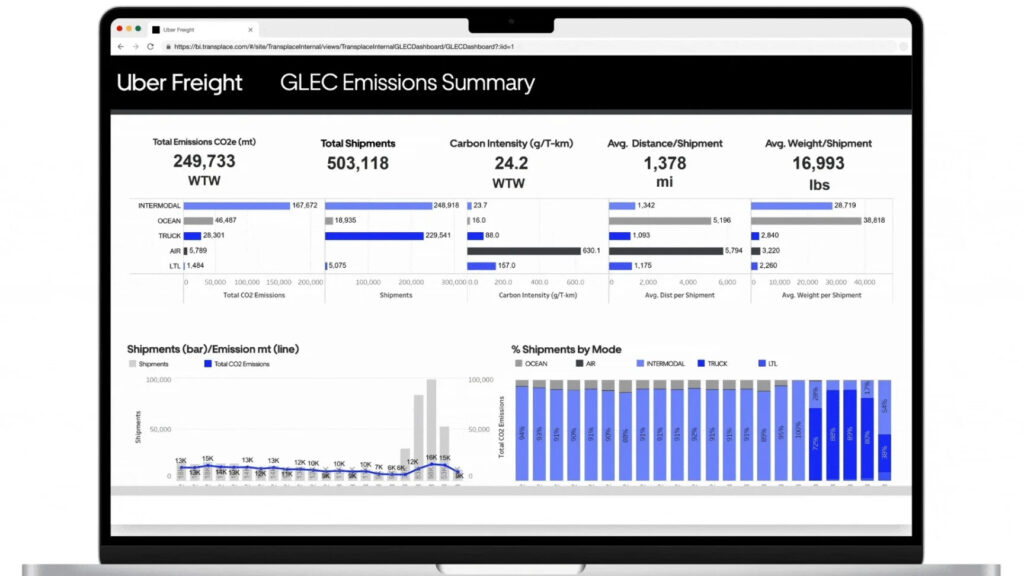
This is where AI transformation aligns directly with ESG outcomes.
4. Data as Competitive Advantage
Here is the strategic insight:
The model is not the moat.
The network data is.
As I’ve written previously on nuno.digital, models commoditise — proprietary data compounds.
Uber Freight benefits from:
- Massive shipment data volumes
- Real-time driver location data
- Pricing history
- Market supply-demand signals
This creates feedback loops.
Better data → better optimisation → better outcomes → more platform adoption → even better data.
This is the flywheel.
What Leaders Should Learn from Uber Freight’s AI Strategy
This case offers several strategic lessons for Emma (Digital Director), Raj (Product Leader), James (Internal Influencer), and Lisa (Strategic Recruiter).
1. AI Strategy Is Operational, Not Cosmetic
AI must be embedded in core workflows.
Uber Freight is not using AI as a feature. It is using AI as infrastructure.
For organisations exploring AI transformation, ask:
Is AI central to value creation?
Or is it layered onto existing processes?
2. Proprietary Data > Model Selection
Many organisations debate which foundation model to adopt.
In logistics optimisation, that question is secondary.
The real differentiator is:
Quality of operational data
Data freshness
Data integration across systems
Without these foundations, route optimisation becomes theoretical.
3. Network Effects Amplify AI Value
AI performs better when:
Systems are interconnected
Data flows continuously
Feedback loops exist
This is why platform thinking matters.
AI transformation is not a departmental initiative — it is an ecosystem strategy.
4. AI Creates Strategic ESG Leverage
Reducing empty miles:
Cuts emissions
Improves fuel efficiency
Increases driver utilisation
This turns AI from cost optimisation into sustainability strategy.
Leaders should look for AI initiatives that deliver multi-dimensional value: economic, operational, and environmental.
The Organisational Capabilities Behind the Scenes
AI-enabled route optimisation requires:
Data engineering maturity
Scalable cloud infrastructure
Model governance
Real-time analytics pipelines
Human-in-the-loop oversight
This aligns directly with AI readiness frameworks I’ve previously discussed.
If your organisation lacks:
Clean, structured operational data
Cross-functional collaboration
A product-led operating model
AI initiatives will stall at proof-of-concept stage.
Uber Freight demonstrates what happens when AI moves beyond experimentation into production at scale.
The Broader Implication: AI as Systems Optimiser
Logistics is just one domain.
The deeper pattern is this:
AI excels at:
Pattern detection
Probabilistic forecasting
Combinatorial optimisation
Resource allocation under constraints
Any industry with similar characteristics — retail supply chains, energy grids, healthcare scheduling, aviation logistics — is structurally suited for AI-driven optimisation.
The strategic question becomes:
Where in your value chain does complexity exceed human cognitive capacity?
That is where AI delivers disproportionate advantage.
Conclusion: From Tool to Transformation
Uber Freight’s AI journey illustrates a critical evolution:
From digital platform
To data platform
To intelligent optimisation engine
This is AI transformation in practice. Not chatbots. Not marketing automation. Not superficial “AI-powered” labelling. But deeply embedded operational intelligence.
For leaders navigating AI strategy in 2026 and beyond, the lesson is clear:
Sustainable AI advantage emerges when data, platform design, and operational execution align.
FAQs
1. How does AI improve truck route efficiency?
AI analyses historical and real-time data to optimise routes, reduce empty miles, forecast demand, and dynamically match supply with demand across freight networks.
2. What are “deadhead miles”?
Deadhead miles refer to distances travelled by trucks without carrying cargo. Reducing these improves profitability and sustainability.
3. Is AI in logistics replacing human planners?
No. In most cases, AI augments planners by providing predictive insights and optimisation recommendations, improving decision quality rather than replacing humans.
4. Why is proprietary data more important than AI models?
Models can often be replicated. Unique operational data, accumulated over time, creates defensible competitive advantage and improves model performance.
5. Can smaller logistics firms adopt AI route optimisation?
Yes — but success depends on data quality, integration capability, and platform maturity. Off-the-shelf tools exist, but strategic advantage requires data ownership.