

Introduction
The launch of OpenAI Frontier marks a subtle but significant shift in how enterprise AI is packaged, governed, and operationalised.
For the past two years, many organisations have experimented with generative AI through prompt interfaces, pilots, and sandbox prototypes. Frontier positions itself not as another model release, but as an enterprise intelligence layer designed to make advanced AI usable, secure, and governable at scale.
In this review, we’ll explore:
What OpenAI Frontier actually is
Core features and architectural positioning
Strengths and limitations in a business context
When you should (and should not) adopt it
Strategic implications for product leaders and transformation executives
What Is OpenAI Frontier?
OpenAI Frontier is positioned as an enterprise-grade AI platform built around OpenAI’s most advanced models. Rather than focusing purely on model capability, Frontier appears to concentrate on:
Enterprise security and compliance
Managed AI deployment
Organisational-scale adoption
Controlled experimentation
Governance and auditability
In essence, Frontier aims to solve a problem many organisations now face:
How do we move from isolated AI experimentation to structured, governed AI capability?
Where early generative AI usage was decentralised and tactical, Frontier is clearly designed for strategic integration.
Core Features of OpenAI Frontier
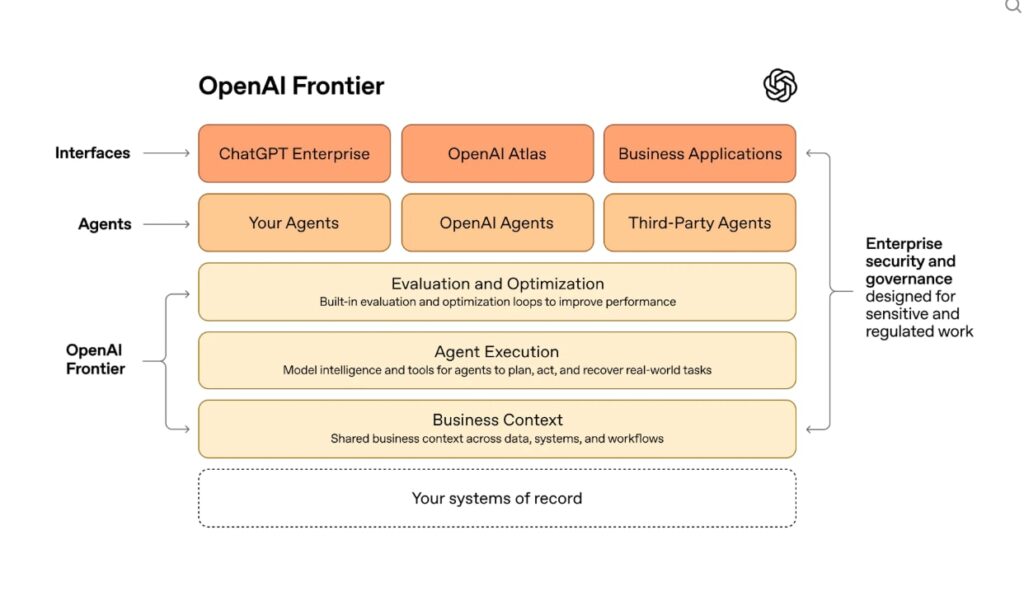
Based on OpenAI’s official materials, Frontier focuses on five strategic pillars:
1. Access to Frontier-Grade Models
Frontier provides access to OpenAI’s most advanced and capable models — optimised for reasoning, multimodal understanding, and complex workflows.
For enterprise users, this matters because:
Higher reasoning depth enables more complex use cases (legal, financial modelling, technical architecture reviews).
Multimodal capabilities support document analysis, structured extraction, and visual reasoning.
Improved reliability reduces the operational risk of hallucination in business-critical tasks.
This positions Frontier not as “ChatGPT Plus for companies” — but as a higher-tier intelligence layer.
2. Enterprise Security & Data Governance
Security and data protection remain the single biggest blocker for enterprise AI adoption.
Frontier reportedly includes:
Enterprise data handling controls
Isolation of customer data
Compliance-focused infrastructure
Administrative oversight capabilities
For organisations operating under regimes such as the EU AI Act or GDPR, governance tooling is not optional — it is foundational.
This is where Frontier becomes strategically interesting.
3. Scalable Deployment
Frontier supports structured deployment across teams and departments.
Instead of ad hoc individual subscriptions, organisations can:
Standardise access
Define user roles
Control usage boundaries
Monitor activity
From a transformation perspective, this enables:
AI Centres of Excellence
Controlled experimentation programmes
AI literacy scaling
Measurable adoption tracking
This is the difference between AI as a tool and AI as organisational capability.
4. Alignment & Safety Mechanisms
Frontier appears to integrate stronger safety frameworks and monitoring systems, aligned with OpenAI’s broader “frontier safety” positioning.
In regulated sectors — finance, healthcare, legal — this becomes critical.
Product teams cannot simply deploy generative systems without guardrails. They need:
Content filtering
Behavioural constraints
Audit trails
Version control
Frontier attempts to provide these foundations.
5. Operational Integration
The real power of Frontier likely lies in integration potential:
API connectivity
Workflow embedding
Data-grounded outputs
Multi-step reasoning tasks
This is where product leaders should pay attention.
The value of generative AI compounds when it is:
Embedded inside CRM flows
Integrated into product analytics
Connected to internal documentation
Orchestrated across business processes
Frontier appears to be positioned for this kind of integration.
Strategic Benefits for Businesses
Let’s evaluate Frontier through a business lens.
1. Reduces Shadow AI Risk
Many organisations already have employees using generative AI unofficially.
Frontier provides:
A sanctioned, governed environment
Centralised visibility
Data security alignment
This mitigates risk without killing innovation.
2. Enables Executive-Level AI Strategy
Executives don’t want prompt engineering tips. They want:
Risk frameworks
Adoption governance
Clear ROI pathways
Frontier supports a more structured AI operating model.
For leaders like Emma, this is less about “better prompts” and more about:
Capability building
Portfolio prioritisation
Organisational maturity
3. Supports High-Value Knowledge Work
Frontier models are particularly useful for:
Complex document analysis
Strategic scenario modelling
Legal summarisation
Research synthesis
Product discovery acceleration
This aligns well with knowledge-intensive enterprises.
4. Positions AI as Infrastructure, Not Experiment
Frontier shifts the conversation from “Let’s try ChatGPT” to:
“Let’s design our AI operating model.”
That’s a significant maturity jump.
Limitations & Risks
However, Frontier is not a universal solution.
1. Cost vs Clear ROI
Enterprise AI tools often face a fundamental challenge:
Cost is predictable.
Value is ambiguous.
Without clear use case prioritisation, Frontier risks becoming:
A sophisticated but underutilised platform.
Organisations must pair adoption with structured AI business cases.
2. Governance ≠ Strategy
Frontier provides infrastructure — not strategy.
It does not answer:
Which AI initiatives to prioritise
Where competitive advantage lies
How to redesign processes
This still requires leadership capability.
3. Over-Reliance on a Single Vendor
Frontier deepens dependency on OpenAI’s ecosystem.
For some organisations, especially those pursuing:
Multi-cloud strategies
Open-source flexibility
Data sovereignty requirements
Vendor concentration may become a board-level concern.
4. Cultural Readiness Is Still the Hard Part
No platform solves:
AI literacy gaps
Organisational resistance
Change management
Incentive misalignment
Frontier accelerates capability — but it does not replace transformation leadership.
When Should You Adopt Frontier?
You should consider adoption if:
You already have decentralised AI usage and need governance
You operate in regulated industries
You are scaling AI beyond pilots
You need structured administrative controls
You are building AI-powered products at scale
You should reconsider or delay if:
You lack a clear AI strategy
You are still in basic experimentation mode
Your data foundations are weak
You cannot articulate measurable business value
Frontier amplifies maturity. It does not create it.
Frontier in the Broader AI Landscape
The enterprise AI race is accelerating.
Platforms from OpenAI, Google, Microsoft, and others are converging on a similar ambition:
To become the trusted AI layer of the enterprise.
Frontier represents OpenAI’s answer to enterprise-scale governance and integration.
The real question for leaders is not:
“Is Frontier impressive?” – this is hype!
It is:
“Does this align with our AI operating model and competitive strategy?”
Conclusion
OpenAI Frontier is not a flashy product announcement.
It is an infrastructure move.
It signals that generative AI is transitioning from consumer novelty to enterprise backbone.
For product and transformation leaders, the opportunity lies in:
Designing AI-native workflows
Embedding governance from the outset
Building internal AI literacy
Aligning AI with competitive differentiation
Frontier can support that — but only if used deliberately.
FAQs
1. What is OpenAI Frontier?
OpenAI Frontier is an enterprise-focused AI platform providing access to advanced models alongside governance, security, and scalable deployment capabilities.
2. Is Frontier different from ChatGPT Enterprise?
Frontier appears to extend beyond conversational access, focusing more heavily on governance, operational scale, and structured enterprise integration.
3. Is Frontier suitable for small businesses?
It may be excessive for early-stage companies without structured AI needs. Smaller organisations might benefit more from standard enterprise AI subscriptions.
4. Does Frontier solve AI governance automatically?
No. It provides infrastructure and controls, but governance strategy must still be designed internally.