
Introduction
The rise of agentic AI is quietly forcing a rethink of one of the most complex parts of the digital stack: commerce infrastructure.
As conversational agents move from answering questions to taking action, buying becomes a machine-mediated process. Agents don’t browse product grids. They don’t click “Add to basket”. They negotiate, reason, and transact on behalf of users — often across multiple surfaces and vendors.
That shift exposes a structural problem: today’s commerce systems were designed for human interfaces, not machine customers.
This article unpacks what UCP is, why it matters, and how it actually works, from an engineering and systems-design perspective.
Why agentic commerce breaks today’s integrations
Traditional e-commerce stacks assume a predictable flow:
Search > Product Page > Basket > Checkout > Payment > Fulfilment
That flow collapses when an AI agent is the primary actor.
Agents need to:
- Discover inventory dynamically
- Validate eligibility (pricing, membership, location)
- Negotiate discounts or alternatives
- Execute payment securely
- Track fulfilment and post-purchase actions
Today, that requires bespoke integrations per surface.
If you have:
- N consumer interfaces (search, chat, voice, assistants)
- N merchants
- N payment providers
You end up with an N × N integration bottleneck — slow, fragile, and expensive.
UCP’s core insight is simple but powerful:
Standardise the commerce lifecycle itself, not the interface.
What UCP actually is
At its core, UCP is an open, protocol-level abstraction for commerce.
It defines:
A shared language for discovery, checkout, payment, and fulfilment
A capability model that agents can dynamically discover
A secure, extensible transport layer for agent-to-business communication
A payment architecture designed explicitly for machine-initiated transactions
Crucially:
Businesses remain the Merchant of Record
Existing retail infrastructure stays intact
Integration is additive, not a rip-and-replace exercise
UCP supports multiple transports:
REST APIs
Agent-to-Agent (A2A)
Model Context Protocol (MCP)
This makes it adaptable to both traditional backends and modern agent frameworks.
The architectural model: capabilities, not pages
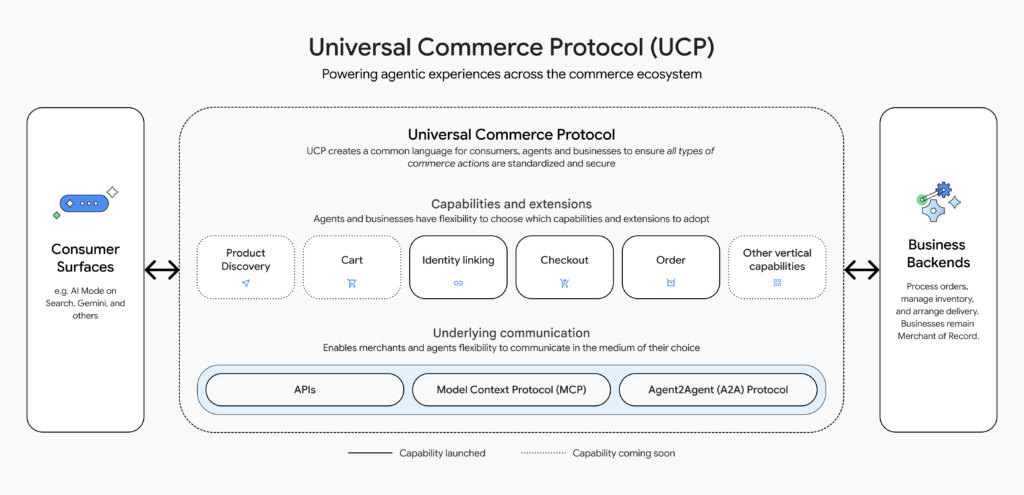
Instead of pages or flows, UCP is built around capabilities.
Capabilities are atomic commerce primitives, such as:
Product discovery
Checkout
Discounts
Fulfilment
Order management
Each capability:
Has a versioned schema
Is independently extensible
Can expose multiple bindings (REST, MCP, A2A)
This means:
An agent can discover what a business supports at runtime
New functionality can be added without breaking existing integrations
Vertical-specific extensions (e.g. travel, grocery, services) can evolve independently
Discovery happens via a standard manifest at:
/.well-known/ucp
From an engineering perspective, this is a clean separation of concerns:
Interfaces become interchangeable
Business logic stays owned by the merchant
Agents reason over capabilities, not UI assumptions
Payments: decoupling instruments from handlers
One of UCP’s most important — and understated — design choices is its payment architecture.
UCP separates:
Payment instruments (what the user uses)
Payment handlers (who processes the payment)
This allows:
Multiple wallets and cards
Multiple processors
Cryptographic proof of user consent
Tokenised, auditable authorisations
For agentic systems, this is critical.
An AI agent must be able to:
Act with explicit, provable consent
Choose appropriate payment routes
Avoid hard-coding payment logic per merchant
UCP’s modular payment handlers make this possible without locking merchants into a single provider.
How UCP works in practice
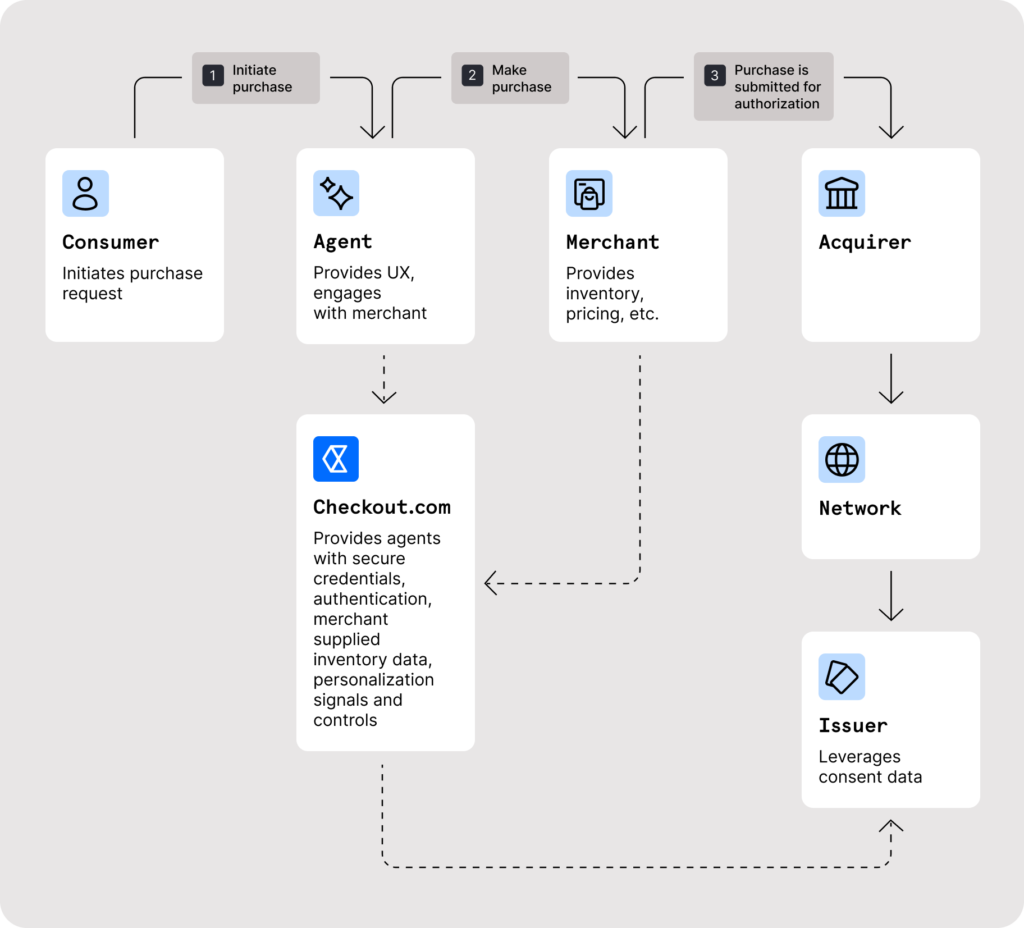
The published walkthrough (using a demo flower shop) shows the lifecycle clearly:
1. Business setup
A merchant exposes:
Products
Capabilities
Payment handlers
All declared via UCP schemas.
2. Capability discovery
An agent queries /.well-known/ucp to understand:
Supported services
Available checkout flows
Discount extensions
Payment options
No pre-integration required.
3. Checkout invocation
The agent:
Creates a checkout session
Supplies buyer context
Chooses eligible payment handlers
All via structured JSON — not UI automation.
4. Dynamic modification
Because checkout is a capability:
Discounts can be applied
Quantities adjusted
Payment options swapped
Without restarting the flow.
5. Completion and fulfilment
The same abstraction supports:
Order confirmation
Status tracking
Post-purchase actions
From an engineering standpoint, this is event-driven commerce, exposed as a protocol.
Why this matters for AI engineers and architects
UCP isn’t just about shopping. It’s about how AI systems interact with the real economy.
For engineers building:
AI agents
Conversational interfaces
Agentic workflows
Commerce platforms
UCP offers:
A stable contract between agents and businesses
A path away from brittle scraping or UI automation
A model aligned with probabilistic, multi-step reasoning
For organisations, it reframes commerce as:
APIs first
Capabilities over experiences
Data contracts over UI flows
This mirrors the broader shift we’re seeing in AI engineering:
Models commoditise. Protocols compound.
Google’s reference implementation (and why it matters)
Although UCP is vendor-agnostic, Google has shipped the first real-world implementation across:
AI Mode in Search
Gemini conversational experiences
For merchants:
Integration happens via Merchant Center
Existing Google Pay credentials reduce friction
Checkout becomes embedded in conversational journeys
This matters less because it’s Google — and more because it proves the protocol can operate at scale, with real payments and real merchants.
The bigger picture: machine customers need standards
UCP should be viewed alongside:
Agent identity standards
Consent and delegation frameworks
Model Context Protocol (MCP)
Agent-to-Agent communication patterns
Together, these form the operating system of agentic commerce.
Just as HTTP standardised the web, UCP is an early attempt to standardise economic action by machines.
Not perfect. Not finished. But directionally important.
Conclusion
If agentic AI is going to transact in the real world, it needs:
Clear contracts
Secure payments
Interoperable systems
Shared semantics
The Universal Commerce Protocol is one of the first serious engineering efforts to meet that need.
For AI engineers, architects, and product leaders, this isn’t a spec to skim — it’s a signal of where commerce, AI, and systems design are converging next.
FAQs
1. What is the Universal Commerce Protocol (UCP)?
The Universal Commerce Protocol (UCP) is an open, vendor-agnostic standard designed to enable agentic commerce, allowing AI agents to discover products, initiate checkout, apply discounts, and complete payments on behalf of users in a secure and interoperable way.
2. Why was UCP created?
UCP was created to solve the N × N integration problem in modern commerce. As AI agents operate across multiple platforms and merchants, traditional bespoke integrations become unscalable. UCP introduces a shared language and capability model that standardises the entire commerce lifecycle.
3. How is UCP different from traditional e-commerce APIs?
Traditional e-commerce APIs are built around human-driven UI flows. UCP is built around capabilities, not pages. This allows AI agents to dynamically discover what a business supports — such as checkout, discounts, or fulfilment — without hard-coded assumptions or UI automation.
4. Does UCP replace existing e-commerce platforms?
No. UCP is designed to work alongside existing retail infrastructure. Merchants remain the Merchant of Record, keep their business logic, and integrate UCP as an additional abstraction layer rather than replacing their current systems.
5. How does UCP handle payments securely?
UCP separates payment instruments (what the user pays with) from payment handlers (who processes the payment). This modular approach supports multiple wallets and processors while enabling cryptographic proof of user consent, making it suitable for AI-initiated transactions.
6. Is UCP tied to a specific vendor or platform?
Although the first reference implementation was built by Google, UCP is open-source and vendor-agnostic. It supports multiple transports including REST APIs, Agent-to-Agent (A2A), and the Model Context Protocol (MCP).
7. Who should care about the Universal Commerce Protocol?
UCP is particularly relevant for:
AI engineers building autonomous agents
Platform architects designing AI-native commerce systems
Product leaders exploring agent-mediated purchasing
Payment and fintech teams preparing for machine customers
8. Is UCP production-ready today?
UCP is still evolving, but it already includes working reference implementations, schemas, and SDKs. Its real-world deployment in conversational commerce environments demonstrates that it is beyond a conceptual spec and actively shaping how agentic commerce will operate.